
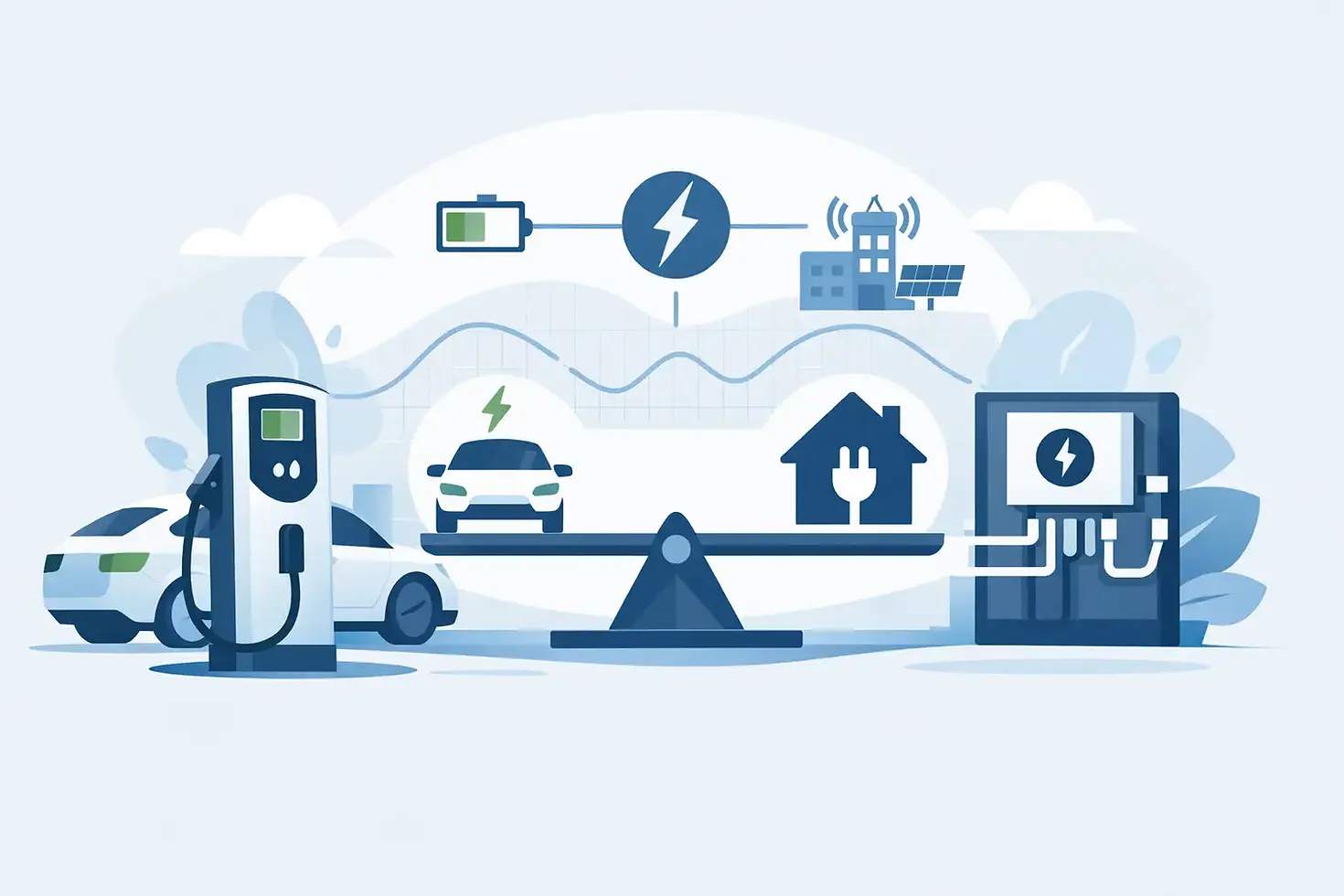
EV Charger Load Balancing Explained Clearly

A car arrives home at 6pm, the oven is on, the heating is running and someone starts charging an electric vehicle. That is exactly the situation where EV charger load balancing explained in plain English becomes useful. It is a safety-led way of helping your property charge an EV without asking more from the electrical supply than it can safely provide.
For many homes and smaller commercial premises across Norfolk and Suffolk, load balancing can make EV charging practical without an immediate and potentially costly supply upgrade. It is not an optional extra in every installation, but it can be the right solution where electrical demand is already high or likely to grow.
What EV charger load balancing actually does
Load balancing monitors how much electricity a property is using and adjusts the charge point's output when necessary. If the house or business needs more power for its normal circuits, the charger temporarily reduces the amount it draws. When demand elsewhere drops, the charger can increase charging again within the limits set for the installation.
The aim is straightforward: keep the total electrical load within the safe capacity of the incoming supply, meter equipment and consumer unit. Rather than allowing an EV charger to take its full rated power regardless of what is happening elsewhere, it shares the available capacity intelligently.
Think of it as priority management, not a restriction on charging. Your essential household or business loads continue to operate as required, while the vehicle charges at the highest sensible rate available at that moment.
A simple home example
A typical single-phase home may have a 7kW charge point, but the property may also be using electricity for an induction hob, electric shower, immersion heater, heat pump or other high-demand appliances. Individually, these are normal loads. Together, particularly at busy times, they can place significant demand on the supply.
With dynamic load balancing in place, the charger detects that demand has risen and may reduce from 7kW to a lower rate for a period. Once cooking, showering or heating demand falls, it automatically allows more power to flow to the car again. For an overnight charge, this usually has little practical impact on the driver, while helping to avoid overloading the installation.
Why the electrical supply matters
A charge point is not simply another socket. It is a substantial, sustained electrical load, often operating for several hours at a time. A proper EV charger installation begins with an assessment of the existing installation, not just a choice of charger brand or charging speed.
An electrician will consider the rating and condition of the consumer unit, the main fuse and incoming supply, the earthing arrangement, existing high-load equipment and the cable route to the parking space. They will also consider future plans. A household installing a heat pump next year, for example, should not assess its electrical capacity solely around today's demand.
The answer is not always load balancing. Some properties need a consumer unit upgrade, additional protective equipment, improved main earth bonding, remedial work or an upgrade to the network supply. In other cases, load balancing is the sensible way to install a suitable charger while working safely within existing limits.
Static and dynamic load balancing
The term load balancing is used for more than one approach, and the difference matters.
Static load management sets a fixed maximum output for the charge point. A 7kW charger might be configured to operate at a lower level because the supply has limited spare capacity. This can be a simple, dependable arrangement, but it does not respond to what the property is actually using at different times.
Dynamic load balancing uses a monitoring device, often fitted around the incoming supply cables, to measure live demand. The charger then varies its output automatically. It can make better use of the capacity available because it responds as the property's demand changes throughout the day.
For sites with several charge points, load balancing can also share available power between vehicles. If two staff cars are charging at a small office, for instance, the system can divide the available capacity rather than allowing both chargers to demand full power at once. As one vehicle finishes or needs less power, more can be allocated to the other.
Dynamic systems cost more than a basic fixed-output installation, and compatibility depends on the chosen charger and site arrangement. However, where supply capacity is tight, they can be far more economical than upgrading infrastructure before it is genuinely required.
Does load balancing make charging slower?
Sometimes, yes. If the building is using a lot of electricity, the charger will reduce its output. That is the intended safety feature, not a fault.
The more useful question is whether the vehicle will still receive the charge needed by the next journey. For many drivers charging at home overnight, there are several hours available and demand in the rest of the property is lower after the evening peak. A short reduction in charging speed may make no meaningful difference by morning.
It may be less suitable where a vehicle has a short turnaround time, high daily mileage or must reliably charge at its maximum possible rate during business hours. In those cases, a larger supply capacity or a carefully designed commercial charging solution may be the better long-term option.
Smart tariffs can also be relevant. Some charge points can be scheduled to charge during lower-cost periods, while load balancing manages the property's electrical limits. These are separate functions, but together they can help control both supply demand and running costs.
EV charger load balancing explained for landlords and businesses
Landlords and property managers need to look beyond a single driver's needs. The electrical capacity of a block, managed property or workplace can be affected by communal loads, tenant use, existing plant and plans for additional chargers later.
Installing one charger without considering future expansion can create unnecessary expense when more residents, employees or visitors request charging. A planned approach can allow for a suitable distribution arrangement, cable routes and load management from the outset, even if only one or two charge points are installed initially.
For small commercial sites, dynamic balancing is particularly valuable when demand fluctuates. A workshop, office, café or retail unit may have busy periods where equipment, lighting, heating or refrigeration is already drawing heavily from the supply. The charging system should respond to that reality rather than compete with essential operations.
It is also worth being clear about the limits of load balancing. It manages demand within an agreed capacity; it does not create extra power. If a property regularly has little or no spare capacity, or the supply and switchgear are unsuitable, electrical upgrading remains the appropriate route.
What a safe installation should include
A qualified electrician should survey the property before confirming the most suitable charging arrangement. This is where clear information helps: the vehicle being charged, likely charging hours, existing electrical equipment, parking location and any planned improvements can all affect the recommendation.
The installation should be designed in line with current electrical requirements, with suitable circuit protection, cable sizing, earthing considerations and testing. Where applicable, notification requirements must also be handled correctly. Neat workmanship and a clear handover matter too, particularly where apps, schedules or charging limits need to be set up.
Be cautious of quotes based only on a photograph of the consumer unit or a request for the cheapest charger. A straightforward installation may be possible, but a proper assessment protects the property, its occupants and the investment in the vehicle and charger.
Choosing the right approach for your property
The right solution depends on the capacity available, how and when you use electricity, and how quickly the vehicle needs to charge. A modest home with low existing demand may not require dynamic balancing. A property with electric heating, an induction hob and a busy family routine may benefit from it immediately. A business expecting several EVs should plan even more carefully.
Eclipse Electrical Solutions LTD can assess the wider installation rather than treating the charge point as a standalone addition. That means identifying whether load balancing, electrical upgrades or a different charging arrangement will give you the safest and most practical result.
A well-designed EV charger should fit around the way your property works. When demand is assessed properly from the start, charging can be convenient, compliant and ready for the changes that electric motoring may bring.


I was juggling between different payment methods and came across the online portal for checking mepco bill details, which made budgeting my monthly expenses so much smoother. It's impressive how it gives you real-time updates on due amounts and history with just a few clicks.